

The Beginning and End of Software
If you haven’t noticed by now, software engineering has undergone a remarkable shift in the past 12 months.
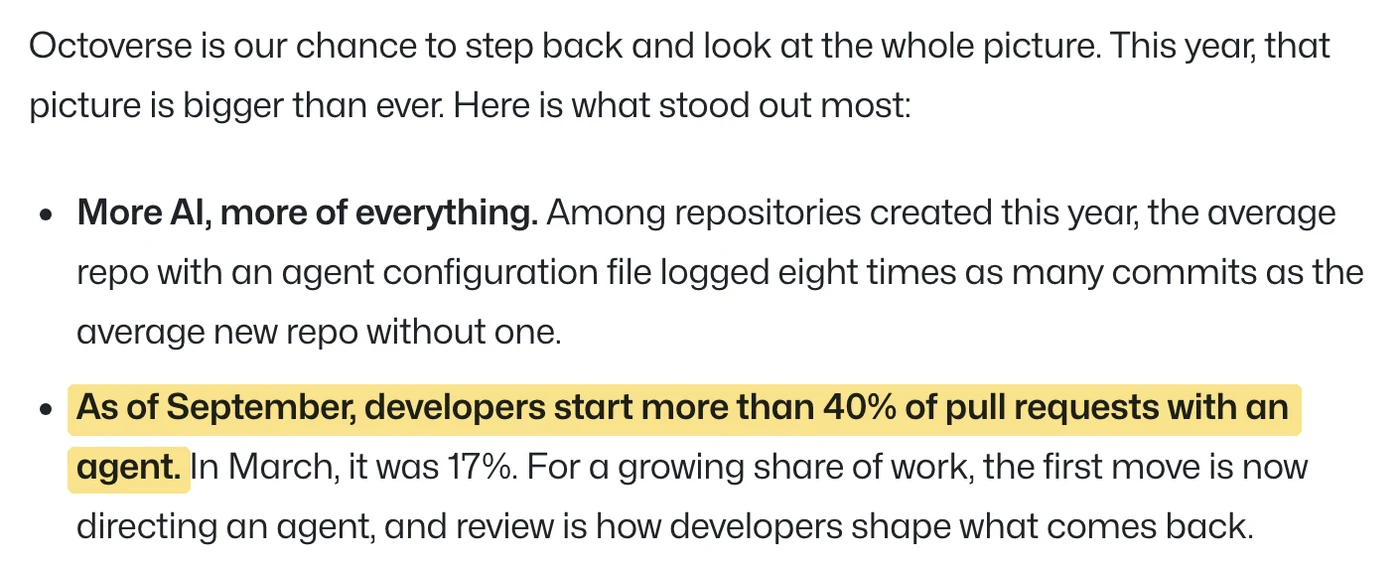
Engineers went from writing code by hand with basic autocomplete to directing AI agents. In mid-2025, most developers in Stack Overflow’s annual survey either didn’t use agents or stuck to simpler AI tools (52%), and 38% had no plans to adopt them. A year later, coding assistants and agents had become the dominant use of AI among developers. Google now says 75% of all new code at Google is AI-generated and approved by engineers, up from 50% the fall before. On GitHub, agents went from writing the first draft of 17% of pull requests in March to more than 40% in September.
The agents are also getting better fast. METR measures how long a task (in human time) an agent can finish half the time. Since 2023, that length has doubled roughly every 131 days, and since 2024, every 89 days.
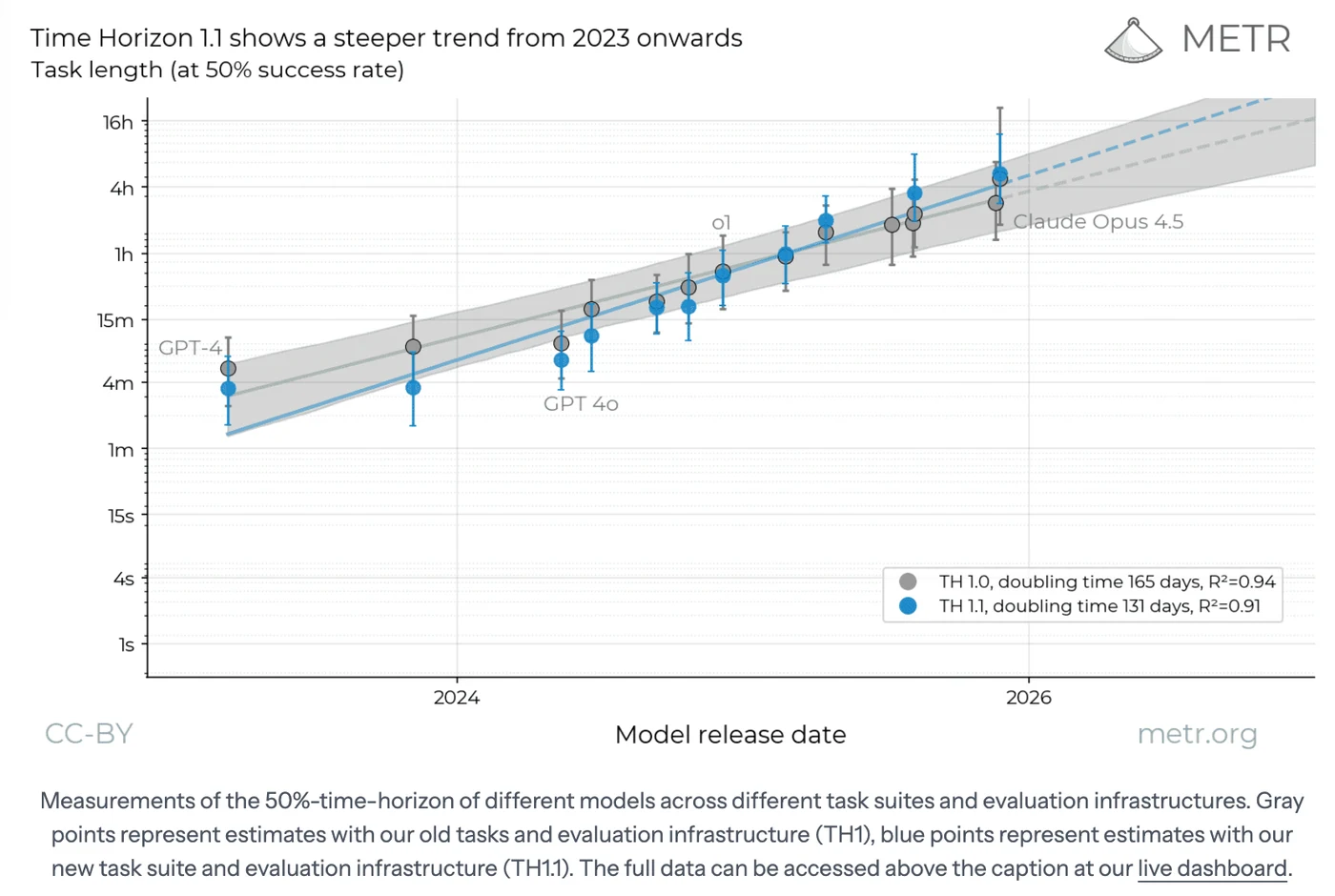 METR, Time Horizon 1.1 (CC BY)
It wasn’t obvious this would happen so quickly. In early 2025, METR ran a careful study and found experienced open-source developers were 19% slower with AI. When they tried to repeat it a year later, they couldn’t get a clean measurement: developers no longer wanted to work without it.
It’s happening to every verifiable domain
Zooming out, this change isn’t just happening to software, but to every domain where an answer can be checked. It shows most clearly in math.
- In July 2025, an advanced version of Gemini Deep Think scored 35 out of 42 at the International Mathematical Olympiad, gold-medal standard, certified by the IMO’s own coordinators.
- By mid-2026, a community tracker run by Terence Tao listed AI as a primary contributor to full solutions of dozens of open Erdős problems.
- In May 2026, an OpenAI model found a counterexample to Erdős’s unit distance conjecture, a question open since 1946. Nine mathematicians, including Tim Gowers, wrote up a human-verified version.
- In September 2026, Claude formalized Fermat’s Last Theorem in Lean: about 13 million lines of machine-checked proof, written largely autonomously over 11 days.
 Alon et al., “Remarks on the disproof of the unit distance conjecture”
Even the Millennium Prize Problems are in play. In September, OpenAI released a Lean-checked proof that the Navier–Stokes equations can blow up in finite time. The Clay Mathematics Institute’s response was careful: the problem has “apparently been settled”, and its review is “deliberately unhurried.” The result relies on an external forcing term, and both the credit and whether the Lean code matches the written proof are still being argued over. But a year ago, nobody would have predicted we’d be having this argument at all.
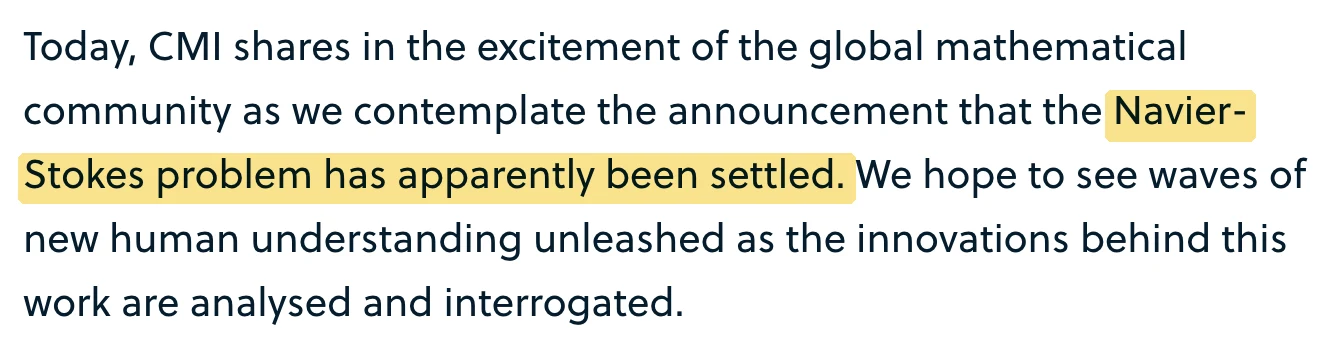 Clay Mathematics Institute, September 11, 2026
Are we automating ourselves away?
So the natural question to ask next is: what happens now? Are mathematics and software engineering doomed to be completely automated away by machines?
While that may seem like the obvious outcome, it’s naive to assume so. The upper bound of “useful software” in the universe is proportional to the number of problems left unsolved, and we are barely scratching the surface of what software can do. Most software that could exist has never been written, because it was too expensive to build, too expensive to maintain, or too risky to trust. Agents attack the first two. The third is where it gets interesting.
Software as an empirical science
To me, this is the beginning of a new era of software. For most of its history, software has been a craft: a skilled person writes it carefully, another skilled person reads it, and we hope the tests caught what both of them missed. Empowered with agents, the software we write will be treated much more like an empirical science. We state what should be true, run experiments against it, measure, and keep what holds up.
The strongest version of “what should be true” is a proof.
One of the most fascinating things to come out recently is AlphaProof Code, announced by Google DeepMind today. They verified Signal’s core encryption code, libsignal, at the level of the machine code that actually runs:
- They compiled the unmodified Rust code with the normal compiler into an Arm executable of about 140,000 instructions.
- They wrote a mathematical model of how an Arm processor running Linux executes a program, in Lean.
- They loaded the compiled binary into that model, byte for byte. Neither the Rust source nor the compiler has to be trusted.
- Teams of Gemini agents then wrote about 6.5 million lines of Lean proof that the binary has the properties Signal promises: forward secrecy, post-compromise security, authentication, and resistance to “harvest now, decrypt later” attacks.
As a test, they put two old, already-fixed libsignal bugs back in. “In both cases, the system produced a machine-checked proof that the buggy version was insecure.”
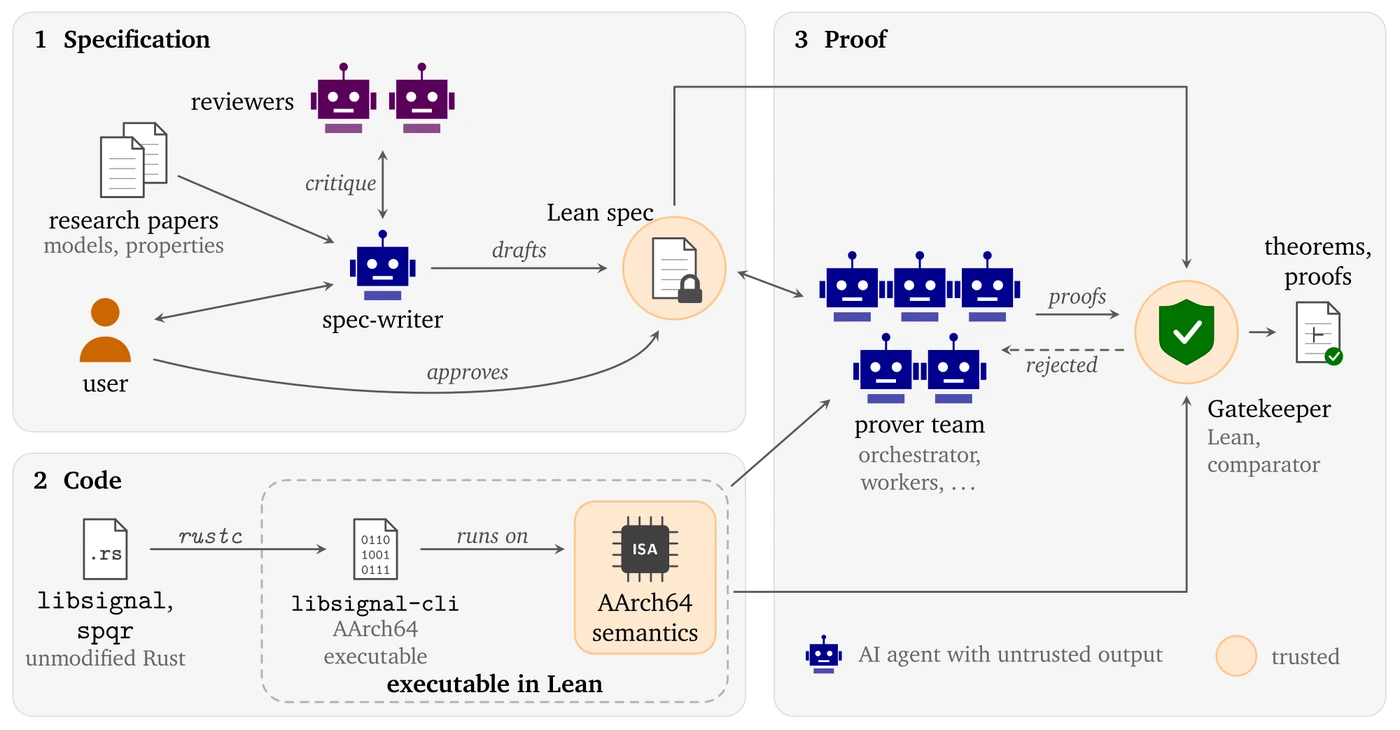 Chaudhuri et al., “AlphaProof Code: Verifying Signal’s Security at the Machine-Code Level”, Figure 1
It took a team of five four weeks. In DeepMind’s words: “Even at this complexity, our verification process took just four weeks.”
Proofs at the scale of real systems
This is probably the beginning of the age when large-scale software systems can be hardened with mathematical proofs.
Previously this was infeasible. The seL4 microkernel, the classic example of verified software, took about two person-years to write and about 20 person-years to verify. So proofs were reserved for places where failure is catastrophic, like avionics and cryptography. With the help of AI agents, that cost is collapsing. In October, Anthropic and Theorem used Claude to prove 123 widely used open-source libraries can’t crash on 239 entry points, finding hundreds of bugs along the way, in a few weeks. Martin Kleppmann predicted this last December, and his reason is the important one: it doesn’t matter if a model hallucinates, because “the proof checker will reject any invalid proof.”
It’s also becoming necessary. The same agents that write code can search for ways to break it, tirelessly, for tens of dollars an attempt. Testing samples the inputs you thought of. A proof covers all of them.
Proofs don’t make software perfect. A proof is only as good as its specification, and AlphaProof Code’s has real limits: the crypto primitives and key generation are assumed correct without proof, and it only models two honest parties. The checker is software too. This summer, AI-assisted researchers found several bugs that let Lean’s kernel accept proofs of false statements. Lean’s response was to ship kernels that are themselves proven correct, one of them written and proven by Claude under human supervision. The hard questions move to two places: did we prove the right thing, and can we trust the referee?
Those are much better problems to have.
This may be the end of software as something we write by hand and hope works. I think it’s the beginning of software we can actually trust.
Sources
- Stack Overflow Developer Survey, 2025 and 2026
- Sundar Pichai, Google Cloud Next 2026, April 22, 2026
- GitHub, Octoverse 2026, October 28, 2026
- METR, Time Horizon 1.1 and developer productivity update
- Google DeepMind, IMO 2025 gold-medal standard
- Alon et al., Remarks on the disproof of the unit distance conjecture, May 2026
- Anthropic, Formalizing Fermat’s Last Theorem, September 2026
- Clay Mathematics Institute, Navier-Stokes announcement, September 11, 2026
- Google DeepMind, Introducing AlphaProof Code and the paper, November 10, 2026
- Anthropic, LLMs are making formal software verification feasible at a much larger scale, October 22, 2026
- Martin Kleppmann, AI will make formal verification go mainstream, December 8, 2025
- Leonardo de Moura, Lean now ships with verified kernels, October 15, 2026